How Patient and Family Engagement Benefits Your Hospital
Despite all those benefits, it's not e'er easy for practices to convince patients to utilise portals — or even to sign upwardly in the commencement place. A recent study of 5,000 Americans plant that only 20 percent were able to schedule medical appointments online and only 15 percent could email their doctor.
How to boost adoption rates? Reinforce the value of the portal to patients, and provide them with specific grooming, according to practices in the athenahealth network that successfully engage with their patients online.
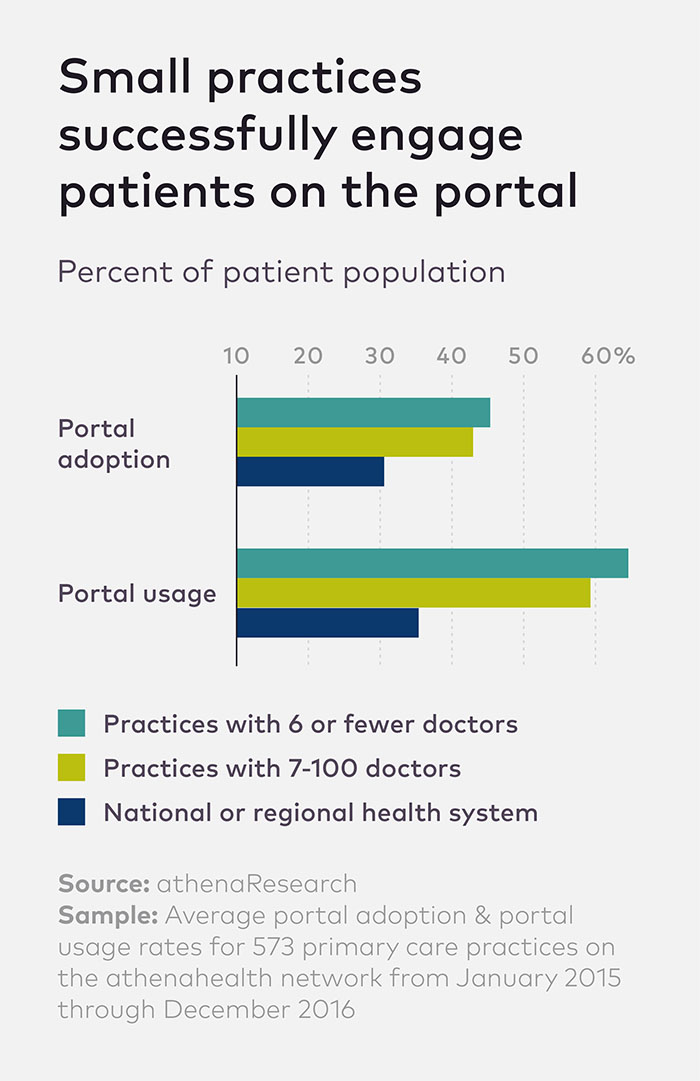
A 2017 athenaResearch written report of well-nigh 600 primary care practices across the network evaluated how successful practices were in getting their patients to register for and appoint with their portals.
The portal adoption rate determines the percentage of patients who registered for the portal prior to, or inside 30 days of, a visit with their doctor. Portal usage rates reflect the percent who interacted with their portal within xxx days of a visit.
Researchers found that small practices — those with six or fewer physicians — had better portal adoption and usage rates than larger regional and national health systems. On boilerplate, 45 pct of patients at small practices adopted the portal, and 65 pct used it within xxx days of an engagement, while national and regional health systems reported but 30 percent adoption and 35 percent usage rates.
While small practices typically have the resources and close patient relationships to exist able to appoint their clients more fully, practices of any size can benefit from adopting a few elementary steps to increment portal utilise among their patient populations. Hither's what ii practices with high adoption and usage rates are doing to engage patients on their portals:
ane. Make portals indispensable for both staff and patients
Whitney Kennedy, One thousand.D., heads upward Highlands Health for Life, a family medicine practice in Denver that boasts an 86 percent portal adoption rate and 86 percent usage rate among its patient population, which ranges from immature, active individuals to older Medicare patients. Kennedy and her team of two physician assistants, front desk staff, and medical assistants drive habitation the importance of the portal by beingness straightforward about its role in medico-patient communication.
"This is how we get your labs back to yous," Kennedy tells patients. "This is how we function."
Practices with loftier portal adoption and usage rates like Kennedy's not only emphasize that the portal is the chief mode of communication for updates, lab results, and appointments, they become every bit far equally possible in making signup mandatory.
"As of this year, if a patient calls to schedule a new-patient appointment, we say, 'Look, you have to go on and annals on the portal,' " Kennedy says. "If we find a calendar week alee of fourth dimension they haven't [registered], we call them to remind them to apply on the portal."
Erin Zielinski, Feingold'south practice manager, says this rapid response time helps patients feel more comfortable with the technology, facilitates easier communication, and encourages them to utilize the portal more than regularly. All of which have helped drive the practice's 75 percent portal adoption and 89 percent usage rates.
2. Prove and tell
High-performing practices discover that the existent sticking ability for portals comes from showing patients how easy and useful these tools are with a hands-on approach.
Zielinski and the forepart desk staff will help patients register for the portal when they're in the office. They fifty-fifty create e-mail accounts for patients who don't already have one. If the patients are unsure of how to use the portal, the team takes them through the step-by-footstep process of logging in and accessing their information.
Kennedy uses a big-screen brandish during patient visits to review portal-based charts and lab results with patients, showing how they've progressed, and explaining the data so they can further digest it at abode. This extra endeavor reduces work for practices in the long run by making patients improve agents of their own care.
"We found that if nosotros discuss [the portal] with the patients, and show them right then and there, they are a lot more attuned to doing it at home," Zielinski says.
At Feingold'southward practice, the goal is to make sure patients empathize the portal before they leave the role.
"We try to become above and beyond, which is I think why the patients are so supportive of the portal," Zielinski says. "Nosotros really endeavour to make it as easy as possible for them."
3. Integrate the portal into each stage of the patient visit
High-performing practices train staff members on every aspect of their portal, the first stride to integrate the portal into each phase of a patient's visit, from check in to check out and beyond.
Kennedy decorated her practice's waiting room herself with printed and framed posters near its portal, and a portal promotional video also runs all day on an iPad.
At Feingold's practice, Zielinski says, they are "constantly driving it home."
When patients check in, the front desk staff reminds them of the portal and helps them sign up. In the examination room, the dr. offers to send additional information, lab results, and answers to questions via the portal. At check out, the front desk staff reminds patients that they can pay bills and ask follow-up questions online.
"Portal. Portal. Use the portal. You get a faster response [from your doctor] through the portal," Zielinski says, repeating the do's mantra.
4. Always improve
Despite boasting loftier portal adoption and usage numbers, Feingold's practice all the same seeks out ways to improve the scope of the tool.
The do, which has been on its portal for upwards of v years, recently signed on with Solutionreach, a partner in athenahealth'south More Disruption Please program, to send text messages to patients when they accept lab results to view in the portal. Zielinski hopes that this next step will continue to heave portal usage and encourage even faster advice.
"We're always trying to come upwards with different ways of doing things to keep [patients] engaged," Zielinski says.
Combining these strategies helps practices take advantage of the portal'southward power to save their fourth dimension and free energy, a welcome convenience in any setting where workloads are high. Streamlined advice allows for "improved continuity of intendance," says Zielinski, and keeps the practice running smoothly.
"Everyone is connected through their prison cell phones. Everyone is pretty tech-savvy now," Zielinski says. "So there is no reason non to use it."
Olivia Rybolt is a staff writer at athenaInsight.
kellehernuatuffivoin.blogspot.com
Source: https://www.athenahealth.com/knowledge-hub/patient-experience/4-keys-patient-portal-engagement
0 Response to "How Patient and Family Engagement Benefits Your Hospital"
Post a Comment